
Our Program of Study
The kindergarten at Stanford Egypt Integrated – International schools offers a well – rounded childhood education with a wide range of activities to excite and inspire our youngest scholars. The KG environment nurtures a child’s innate curiosity, allowing him or her to explore education in a unique and personalized way. We maintain suitable classroom sizes to look after each child needs.
The Kg curriculum solidifies academic foundations of reading and writing in both English and Arabic. All learning is integrated with most advanced technology, Touch panels which are in all classrooms with specialized applications to challenge our students while stimulating their imaginations and creativity.
Further, in our KG education goes beyond academics. We provide a safe and happy environment where our children explore friendship and develop the four fundamental social skills they will need to thrive their emerging world.
Our individual attention and loving care give our little ones the best advantages and opportunities for their promising futures.
We teach them English ( Oxford Little Blue Dots) form pre-K to KG2, jolly Phonics , Drama , Etiquette , Math , Science , Montessori , Arabic , Noor Bayan ,Quran physical Education , Music and Art .
French and German are taught orally in KG1 and KG2, Mental Math is taught starting from KG2.

The Elementary school
Stanford Egypt Elementary School adopts the transformational reform of the ministry’s approach of the New Curriculum 2.0 in which the foundational skills of literacy, numeracy and digital literacy is at core. The school is dedicated to the integration of the essential soft skills and competencies such as communication and critical thinking into the school curriculum in all disciplines. We pride ourselves with providing our students with the 21st century skills needed for successful learning in the classroom, so students can thrive in a world where change is constant and learning never stops.
The school follows the international standards of EFL (English as a foreign language) learning to provide the students with ample room for the innovation and creativity essential to learning. This creates autonomous learners who are in control of their learning process rather than being passive recipients of information.
who contribute to the local and international community.
Elementary School includes the grades from One till Six. The students learn: English, Arabic, Math, Science, Religion, Social Studies, French and German.
Starting from first Primary, students have the choice of learning either French or German as a second language. Social Studies is learned starting from Fourth Primary, however it is introduced in (Connect Plus) books of the English from early grades in the CLIL (Content Language Integrated Learning) section which serves as a simple introduction to social studies. Students have activities: P.E, music and art on weekly basis as part of the schedule.
Our staff, which consists of the highest quality local and international teachers, works closely with our administrative body to assure that each student is provided with an individualized learning experience. Our education perspective at Stanford Egypt stems from the idea that contemporary people live and interact in an increasingly globalized world. For this reason, it is essential to give students a global education and provide them with an expanded world view. We believe that this approach allows our students to go forth in the world with the proper tools to succeed.
At Stanford Egypt School, our students are the top priority. Every lesson plan, school activity, and administrative decision made within our workplace addresses the essential question: “What is best for our students?” We believe that it is imperative that our school be equipped to cater to the diverse and multicultural needs of every child in a manner that prepares them for what line Modern American School, our students are the top priority. Every lesson plan, school activity, and administrative decision made within our workplace addresses the essential question: “What is best for our students?” We believe that it is imperative that our school be equipped to cater to the diverse and multicultural needs of every child in a manner that prepares them for what lies ahead. At the Modern American School, our students are the top priority. Every lesson plan, school activity, and administrative decision made within our workplace addresses the essential question: “What is best for our students?” We believe that it is imperative that our school be equipped to cater to the diverse and multicultural needs of Very child inaner that prepares them for what lies ahead.
Stanford Egypt preparatory stages set curriculum goals considered essential to the learning process of its students. The goals are set in order to acquire a range of thinking skills, alongside comprehension, interpretation, inference and synthesis.
Goals include teaching students to think critically and make connections, especially during English language and literature classes which is a semi-international approach.
The aim is for students to become confident performers, presenters, and public speakers who work cooperatively and collaboratively. Students are taught to acknowledge their peers’ points of view and respond in an open-minded manner.
We also integrate separate subjects into a functioning, unified, and harmonious whole which assists students to identify the links, not only between ideas and processes within a single field, but also between ideas and processes, in separate fields, and in the world outside of school.

ICT Development Plan for Stanford Egypt Schools
1. ICT Curriculum
Objective: To provide a comprehensive ICT curriculum that equips students with foundational and advanced digital skills.
Implementation:
· Primary Levels: Focus on foundational ICT skills such as typing, basic coding (e.g., Scratch), internet safety, and digital tools for creativity (e.g., drawing software).
· Middle Levels: Introduce intermediate topics such as word processing, spreadsheets, multimedia presentation tools, and coding languages (e.g., Python).
· Secondary Levels: Offer advanced ICT topics like web development, data analysis, cyber security, and app development. Students will engage in project-based learning to apply these skills in real-world scenarios.
Teacher Training: Ensure all ICT teachers receive ongoing professional development in emerging technologies and teaching methodologies.
2. After-School ICT Clubs
Objective: To provide students with opportunities to explore ICT beyond the classroom, encouraging creativity, collaboration, and innovation.
Proposed Clubs:
- Coding Club: Teach students programming skills through fun projects such as game development or robotics.
- Digital Media Club: Train students in video editing, graphic design, and podcast creation.
- Robotics Club: Engage students in hands-on learning using kits like LEGO Mind storms or Arduino.
- Tech Support Club: Empower students to assist with school ICT infrastructure, troubleshooting, and maintenance.
3. Cross-Curricular Integration
Objective: To integrate ICT seamlessly across all subjects to enhance learning and engagement.
Strategies:
· Science: Use simulation software to visualize experiments and conduct virtual labs.
· Mathematics: Introduce data analysis tools and graphing software to solve complex problems.
· History: Utilize interactive timelines and digital storytelling tools.
· Art: Teach digital design and animation using software like Canva or Adobe Illustrator.
· English: Encourage digital publishing of creative writing and use grammar-checking tools.
Collaboration: Subject teachers will collaborate with the ICT department to design lesson plans incorporating technology.
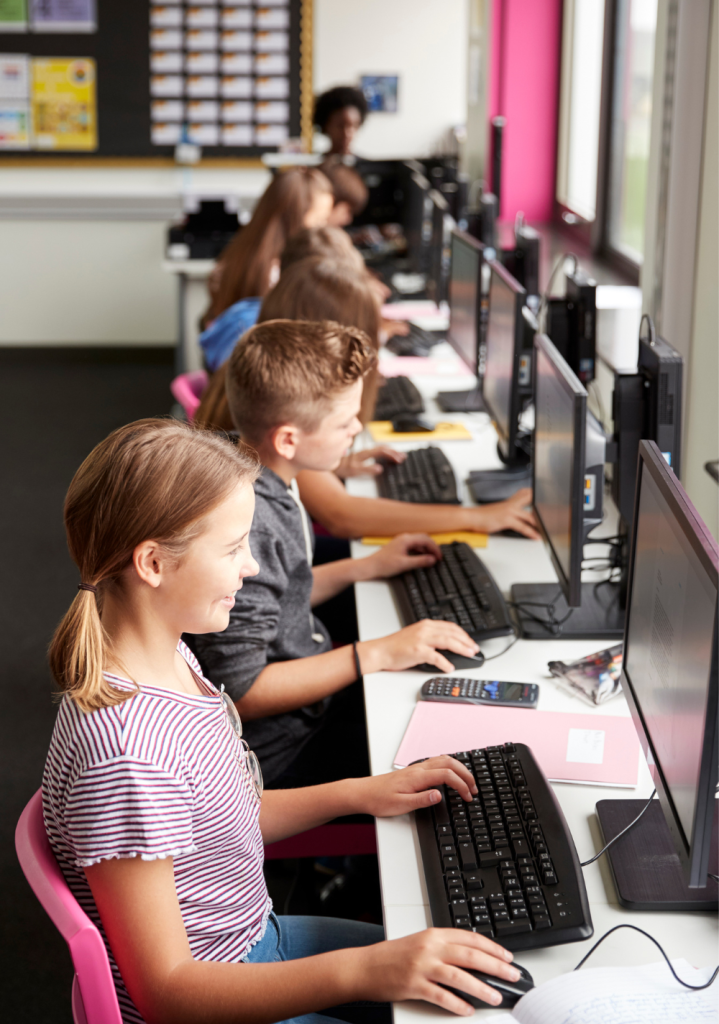
4. Technology Integration in Teaching and Learning
Objective: To enhance teaching methodologies and learning experiences through technology.
Approach:
· Interactive screen panel: Equip classrooms with screen panel for dynamic lesson delivery.
· Learning Management Systems (LMS): Adopt platforms like Google Classroom or Microsoft Teams for assignments, discussions, and feedback.
· Digital Devices: Provide students access to tablets or laptops for research and interactive learning.
Monitoring and Evaluation:
· Regular feedback from students and teachers on the effectiveness of technology integration.
· Annual reviews to update the ICT tools and resources based on technological advancements and pedagogical needs.
Stanford Egypt School, Cairo, Egypt, provides its students with quality education, qualified Programs of international education while maintaining their cultural identity
Stanford Egypt School provides its students with quality education, qualified teachers and challenging programs of international education while maintaining their cultural identity as Egyptians. Stanford Egypt is committed to empower its students with the skills, technology and knowledge to meet the requirements of college and career. We strive to create a disciplined, safe, happy and caring atmosphere that encourages students to be responsible, confident, compassionate, and well-informed citizens who contribute to the local and international community.